

Hustle and Flowers Detroit Florist Movement and the Gift and the Curse

A flower shop can be more than a place to buy roses. In the right hands, it can become a stage, a studio, a second chance, and a neighborhood lesson wrapped in stems and sound.
That is the world of Hustle and Flowers, a Detroit-born parody inspired by the spirit of Hustle & Flow, but flipped into something stranger, funnier, and more hopeful. Instead of chasing a rap dream from the margins, CLAWED is a hustler turned florist with one big mission: convince the people around him that Detroit flowers can be a real lane.
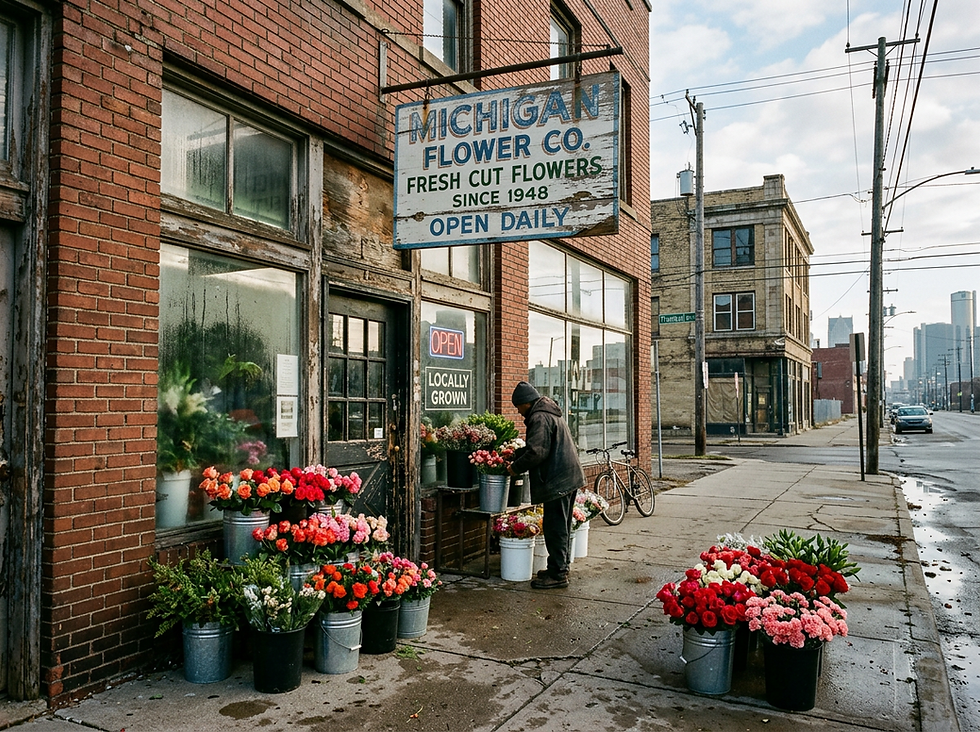
He is not preaching from a distance. He knows the streets. He knows the music. He knows what it means to build something after the old life stops fitting. CLAWED was once a rap producer, then he retired from the game in 2006. Now, in 2026, he is back with a flower shop on the ground floor, a music studio upstairs, and a movement growing from the block up.
The soundtrack is called The Gift and The Curse, inspired by music by Byrd 100. It carries the weight of the past and the push toward something cleaner, sharper, and alive.

A parody with a real heart behind the joke
The setup sounds funny because it is funny. A retired rap producer named CLAWED trying to talk drug-dealing friends into becoming florists has the kind of contrast that makes parody work. It takes something familiar, twists it, and lets the audience see the old story from a fresh angle.
But the idea lands because it is not only a joke.
In Hustle & Flow, the tension comes from wanting out, wanting a voice, and wanting one lucky break to mean something. Hustle and Flowers keeps that emotional engine, then changes the destination. CLAWED is not trying to become the next rap star. He is trying to build a new system around flowers, music, and the kind of work that can be done in the open.
That flip matters.
A flower shop is public. People walk in for birthdays, funerals, apologies, weddings, graduations, and “just because” moments. Flowers handle grief and celebration in the same cooler. They move through every part of life. That makes the shop a perfect symbol for reinvention.
CLAWED is not asking his friends to become fake versions of themselves. He is asking them to use the same nerve, timing, loyalty, and street knowledge in a different trade.
The parody gives people permission to laugh. The story gives them something to think about after the laugh is over.
CLAWED is a florist with a producer’s ear
CLAWED makes sense as the center of this world because floristry and music production share a hidden rhythm.
A producer listens for texture. They know when a track needs space, when the drums are too loud, when the hook needs to bloom. A florist works the same way with color, height, scent, and shape. Too much red can overpower a piece. Too many tall stems can kill the balance. One unexpected flower can change the whole arrangement.
That makes CLAWED’s second act feel believable. He did not lose his instinct when he left music in 2006. He carried it into another craft.
In the shop, he still produces. The tools changed.
Instead of samples, he works with stems.
Instead of a mixing board, he works with buckets and clippers.
Instead of artists in the booth, he works with customers telling him what the flowers need to say.
Instead of chasing a placement, he builds a movement that people can touch.
The name CLAWED also fits the character. It suggests someone rough around the edges, someone who has had to grab for survival, someone who still carries marks from the life behind him. A claw can damage, but it can also hold on. In this story, CLAWED holds on to his talent, his neighborhood, and his people.
He is a florist, but not in a soft-focus way. He is not pretending the past never happened. The flowers do not erase the streets. They grow out of the concrete around them.

The flower shop becomes the block’s new studio
The smartest part of the concept is the building itself. The flower shop sits downstairs. The music studio sits above it. That layout says everything.
Downstairs is the business people can see. It is legal, beautiful, daily, and grounded. Customers come in. Orders go out. The cooler hums. The register opens. Someone learns how to prep stems, wrap bouquets, clean buckets, price arrangements, and talk to people who are spending money on emotion.
Upstairs is where the sound gets made. That is where CLAWED and his Band of Hood-Alums turn the story into music.
“Hood-Alums” is a strong phrase because it does not treat the neighborhood like a phase people simply escape. An alum is someone who graduated from somewhere. They still carry the lessons, the scars, the slang, the wisdom, and the warnings. CLAWED’s crew members are not outsiders studying Detroit from a safe distance. They are people shaped by the same environment, now trying to put that experience into a different form.
The studio above the shop creates a natural rhythm for the story:
Morning brings flower deliveries.
Afternoon brings customers, arrangements, arguments, jokes, and neighborhood pressure.
Night brings recording sessions upstairs, where the day’s wins and losses become verses, hooks, and beats.
That structure gives The Gift and The Curse a reason to exist. It is not just an album made near a flower shop. It becomes the sound of the shop. Every track can feel tied to a shift, a sale, a disagreement, a memory, or a choice.
The building becomes a character. The stairs between the shop and the studio become the bridge between what CLAWED was and what he is building next.
The Gift and The Curse sounds like a second chance
The title The Gift and The Curse carries tension before the first song even plays.
The gift is talent. Vision. Street sense. Musical instinct. The ability to read people. The courage to start over when staying the same would be easier.
The curse is history. Old habits. Old friends who do not understand the change. The weight of reputation. The fear that no matter how many flowers CLAWED sells, the world will still see the old version of him first.
That is a real conflict. It gives the music a reason to hit harder.
Inspired by music by Byrd 100, the soundtrack can live in the space between grit and uplift. It does not need to sound polished to the point of losing its teeth. The story calls for music with dirt under the nails, bass in the floorboards, and hooks that feel like they were written after closing time.
The album also gives the movement a voice. Flowers create the image, but music carries the message farther. A customer might walk into the shop because they like roses. They might stay with the movement because the soundtrack tells them why the roses matter.
The gift is knowing how to create. The curse is deciding what to do with that gift after survival is no longer enough.
That is the heart of CLAWED’s story. He is not just selling flowers. He is selling the possibility that the same energy once used to survive can be turned into something that feeds the block instead of draining it.

Turning dealers into Detroit florists is the real punchline
The funniest line in the whole premise is also the sharpest: CLAWED wants his drug-dealing friends to become Detroit florists.
That idea works because it refuses to make change look clean or easy. Nobody hears “become a florist” and instantly drops every old pattern. Friends laugh. They test him. They call it soft. They question the money. They wonder who respects a bouquet when the old life came with faster cash and louder fear.
CLAWED has to make the case in a language they understand.
He can talk about inventory, but not like a textbook. Flowers are perishable. If you do not move them, you lose money. That teaches timing.
He can talk about delivery routes. That teaches planning.
He can talk about regular customers. That teaches trust.
He can talk about weddings, sympathy arrangements, and weekly accounts. That teaches consistency.
He can talk about presentation. That teaches pride.
The joke opens the door, but the work keeps it open. Floristry is not a fantasy hustle where everything becomes easy. It is early mornings, cold water, sharp tools, heavy buckets, picky customers, and flowers that do not care about your mood. That makes it a strong metaphor. The beauty only shows after the labor.
For CLAWED’s friends, the shift is not from “hard” to “easy.” It is from risky to rooted.
The phrase Detroit Florist Movement can mean more than a shop name or a campaign phrase. It can mean a new identity. It can mean people learning to own a craft, serve their neighborhood, and tell a different story about what can come from the same streets.
Detroit gives the story its texture
This story could not feel the same without Detroit.
Detroit carries music history, industry history, neighborhood pride, and a deep record of people making something from what others overlook. The city knows rhythm. It knows machines. It knows loss. It knows rebuilding. That makes it the right soil for a story like Hustle and Flowers.
A Detroit flower shop is not just a cute backdrop. It can sit near boarded windows, new construction, old churches, corner stores, family homes, and streets where everybody knows who used to be who. That mix gives the story pressure.
CLAWED cannot reinvent himself in private. The neighborhood sees the change. Some people support it. Some people doubt it. Some people wait for him to fail. Some people need him to win because his win gives them language for their own.
That is where the movement gains its power. It does not ask Detroit to be cleaned up for the camera. It lets the city be complicated, funny, hard, musical, and full of people who still create.
Why the movement feels bigger than a parody
A good parody does more than copy the shape of something famous. It exposes what was sitting inside the original idea, then turns it toward a new purpose.
Hustle and Flowers has comedy baked into the concept, but the movement underneath is serious:
People deserve second acts.
Creative skills can transfer into trades.
Neighborhood businesses can become cultural spaces.
Music can document change as it happens.
Beauty can be practical, not just decorative.
That last point matters most. Flowers often get treated as luxury items or background decoration. In this story, they become tools of transformation. A bouquet becomes proof that someone learned a craft. A delivery becomes proof that someone kept their word. A shop becomes proof that a block can hold more than one kind of hustle.
The movement does not need to deny the past to move forward. It can name the curse and still choose the gift.

Follow the movement as it grows
By 2026, CLAWED’s story becomes more than a comeback. It becomes a soundtrack, a shop, and a challenge to everybody watching from the sidewalk.
The Gift and The Curse gives the movement its sound. The flower shop gives it a home. The Band of Hood-Alums gives it voices. Detroit gives it truth.
That combination is what makes the idea stick. A retired rap producer leaves the game in 2006, then returns twenty years later with flowers in his hands and music upstairs. He is still producing, just in a way nobody expected.
Follow the movement at HoodFlorist.com.
The takeaway is simple: CLAWED is not asking people to forget where they came from. He is showing what can grow when they decide the next hustle should leave something beautiful behind.


Comments