

Claude Neighbors and the Rise of CAMFlorist from Phancies to Detroit Stores

Claude Neighbors did not arrive in Detroit floristry with a perfect plan. He arrived with bruises.
There were the quiet failures, the kind that do not make good social posts. The wrong products at the wrong time. A website that felt clever until it confused people. Long nights wondering if flowers could carry more than beauty, if they could carry a business. Then came the hack, the kind of digital ambush that can make a small founder feel like the floor has shifted beneath every account, password, page, and promise.
Still, Claude kept returning to the same idea: Detroit deserved a florist that felt personal, fast, local, and emotionally sharp. Not just roses in a vase, but arrangements with a pulse. That idea moved from CLAWED @ Phancies.com to CAMflorist.com, and now toward something more visible: CAM-Florist stores planned for Uptown and Downtown.
His story is not a clean before-and-after. It is a fight between memory and reinvention, between human instinct and an AI agent named CLAWED, between an abandoned domain and a storefront dream.

Detroit floristry does not leave much room for hesitation
Detroit is a serious place to sell flowers.
The city has long understood ceremony. Weddings, funerals, church events, birthdays, apologies, graduations, memorials, new apartments, grand openings, and Sunday tables all come with flowers. That demand creates opportunity, but it also creates pressure. A florist in Detroit competes with legacy shops, grocery store bouquets, national delivery networks, event designers, and customers who know exactly what a good stem should look like.
Claude stepped into that world with a mix of confidence and uncertainty. He had taste. He had ideas. He had a name that stuck in the mind: CLAWED. It sounded sharp, a little strange, a little risky. For a creative person, that was part of the appeal.
But floristry is not only about taste. It is also cold storage, delivery timing, supplier relationships, substitutions, customer service, funeral etiquette, prom season chaos, and the discipline to turn perishable inventory into profit before petals soften.
That reality forced Claude to ask harder questions.
Could he build something that was artistic without being inaccessible? Could he serve Detroit customers who needed same-day reliability and still keep a distinct voice? Could he recover from the parts of the journey that did not work?
The answer began to form when he stopped treating the business as a concept and started treating it as a store.
The city grant application became a mirror
Applying for a city grant to open CAM-Florist was not just paperwork for Claude. It was a test of whether the business made sense outside his own head.
Grant applications have a way of doing that. They ask plain questions that creative founders often avoid until they have to answer them:
What are you opening?
Who will it serve?
Where will the money go?
How will the business survive after the first burst of attention?
What does the neighborhood gain?
For Claude, the CAM-Florist application turned ambition into a checklist. He had to think about refrigeration, build-out costs, signage, point-of-sale systems, delivery equipment, inventory, staffing, insurance, and rent. The romance of flowers met the math of opening a door every morning.
That process also forced him to explain why CAM-Florist mattered. A florist can look simple from the outside, but a strong shop becomes part of the emotional infrastructure of a neighborhood. People call florists during joy and grief. They trust them with messages they cannot say in person. They ask them to interpret feelings through color, shape, scent, and timing.
Claude’s grant application had to make that case. CAM-Florist would not be just another flower counter. It would be a Detroit flower business built from previous mistakes, designed to be practical enough to last and personal enough to matter.
The grant process did not erase the risk. It made the risk visible.

Failure followed him, but it also trained him
Claude’s earlier attempts did not disappear when CAMflorist.com began to take shape. They followed him.
Some failures were practical. A name might attract attention but fail to explain the service. A page might look interesting but not convert a shopper who needs sympathy flowers delivered by 3 p.m. A product idea might feel original but create too much waste. A design choice might impress friends and confuse paying customers.
Other failures were emotional. It is hard to keep building after something does not work. It is harder when the public version of a project looks bold while the private version feels unfinished.
Then came the hack.
For a small business owner, getting hacked is not an abstract tech problem. It can feel personal. It can interrupt sales, damage trust, lock away work, and make every system feel suspect. Even if the damage gets contained, the memory stays. Every login becomes a reminder. Every platform decision carries a question: how exposed are we?
Claude had to rebuild with that fear in the background.
That experience shaped the move from Phancies.com to CAMflorist.com. The newer direction needed to feel cleaner, safer, and easier for customers to understand. It had to reduce friction. It had to say, without overexplaining, that this was a florist.
CAMflorist.com gave the business a clearer front door.
The old name had personality. The new name had function. For a business trying to sell perishable beauty in a competitive city, function mattered.
From CLAWED @ Phancies.com to CAMflorist.com
The original brand, CLAWED @ Phancies.com, carried a certain electricity. It sounded like an art project, a persona, a digital creature with claws in the wall. It suggested taste, edge, and experimentation.
That was also the problem.
A customer searching for anniversary flowers might not know what to do with it. A family ordering funeral arrangements may prefer clarity over mystery. A venue coordinator may need a name they can remember, spell, and trust after one conversation.
Phancies.com may have held Claude’s early creative energy, but CAMflorist.com carried the business closer to the customer. The shift marked a real change in priorities.
CLAWED @ Phancies.com felt experimental, personal, and hard to classify.
The old identity invited curiosity.
Phancies.com belonged to the origin story.
CAMflorist.com feels direct, service-based, and easier to connect to flowers.
The new identity invites orders.
CAMflorist.com belongs to the storefront plan.
The evolution was not a rejection of Claude’s creativity. It was a decision to put the customer’s need first. If someone needs flowers in Detroit, the name should not make them solve a riddle.
Still, letting go of Phancies.com was not simple. Old projects carry ghosts. They remember the first version of a dream before rent, invoices, logistics, and security concerns get involved.
That is where CLAWED became more than a name.
CLAWED became the voice in the room
CLAWED, Claude’s AI agent, sits in a strange place in the CAM-Florist story.
On one level, CLAWED is a tool. It can help Claude think through product categories, compare store ideas, draft messages, plan inventory, organize tasks, and test assumptions before money gets spent. For a founder with too many decisions and too few quiet hours, that kind of support can be useful.
But CLAWED is also tied to the old identity. The name comes with history. It reminds Claude of Phancies.com, of the sharp-edged beginnings, of the part of the business that wanted to be more than a florist.
That creates tension.
Claude wants CAM-Florist to be clear. CLAWED keeps pulling memory back into the room. Claude wants a store that customers can walk into. CLAWED can think endlessly in systems, scenarios, and alternate futures. Claude has to make choices in the real world, where flowers wilt and leases come due.
The most useful AI agents do not make decisions for people. They make the cost of each decision harder to ignore. CLAWED seems to do that for Claude. It can surface risks, challenge weak plans, and preserve ideas Claude might otherwise discard too quickly.
But it can also keep old doors open.
Phancies.com is the clearest example. To Claude, abandoning it may feel like growth. To CLAWED, it may look like lost equity, lost story, lost signal, or unfinished work. The AI can keep asking whether the old domain should become an archive, a side project, a creative label, or a hidden root beneath CAM-Florist.
Claude has to answer a more human question: does keeping Phancies.com alive help the business, or keep him emotionally split?

The abandoned Phancies.com still has a pull
Every founder has a version of Phancies.com.
It is the first name, the first logo sketch, the first half-built site, the first identity that felt alive before the market responded. People outside the journey may see only an abandoned domain. The founder sees late nights, confidence, embarrassment, hope, and money already spent.
For Claude, Phancies.com represents the part of him that wanted to make something unusual. It was not plain. It did not sound like a traditional flower shop. It gave CLAWED a home and gave Claude a myth to build around.
CAMflorist.com asks for a different kind of courage. It is less mysterious. It stands closer to the street. It has to work at a glance.
That shift can feel like a compromise, but it may also be maturity. A florist can still be expressive under a clear name. Creativity does not vanish because the URL makes sense. If anything, clarity gives the arrangements more room to speak.
The tension between Claude and CLAWED may never disappear, and maybe it should not. CLAWED can guard the wildness. Claude can guard the business. CAM-Florist needs both, as long as one does not sabotage the other.
CAM-Florist is becoming a physical promise
A website can announce a business. A store has to prove it.
Claude’s plans for Uptown and Downtown locations raise the stakes. Two Detroit storefronts would mean two daily rhythms, two sets of neighbors, two customer flows, and two chances to become part of local routines.
Uptown could give CAM-Florist room to build relationships around homes, churches, events, and everyday flowers. Downtown could place the shop closer to hotels, offices, apartments, restaurants, performances, and last-minute gifting. Each area would ask for a slightly different version of the same business.
The challenge will be consistency. Customers should feel the same care whether they order online, walk into Uptown, or stop by Downtown. The flowers can change with the season. The tone can adjust by neighborhood. The promise should stay steady.
For Claude, opening stores also means stepping out from behind the screen. The hack, the failed starts, the abandoned Phancies.com, the grant application, and the long conversations with CLAWED all point toward this next test.
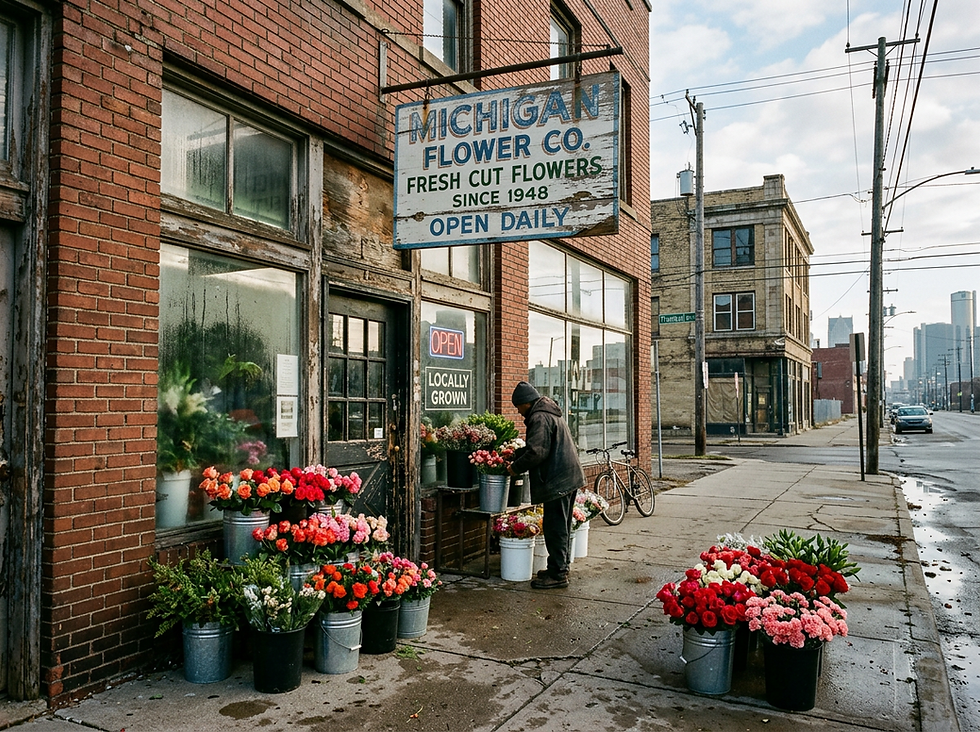
Can CAM-Florist become real in brick, glass, buckets, coolers, receipts, delivery routes, and repeat customers?
That is the question every storefront asks.

What Claude’s story says about building after setbacks
Claude Neighbors and the Rise of CAMFlorist from Phancies to Detroit Stores is a founder story, but it does not follow the polished version of entrepreneurship. It has detours.
It shows how a business can begin as a creative identity, get tested by failure, get shaken by a hack, and still find a clearer shape. It shows how AI can help a founder think, while also complicating the emotional work of letting go. It shows how grant applications can force discipline, not just funding. It shows how a simple URL can mark a major shift in strategy.
Most of all, it shows that reinvention often feels less like a grand reveal and more like a series of hard edits.
Claude is editing now. Phancies.com may remain part of the origin story, but CAMflorist.com is the name moving toward the street. CLAWED may keep questioning the past, but Claude has to choose the future. Uptown and Downtown are no longer abstract dots on a plan. They are the places where the idea will either root or wither.
For a florist, that feels fitting.
Every arrangement begins with cuts. Stems are trimmed. Leaves are removed. Shapes are adjusted. What remains is not the untouched original. It is the version strong enough to stand in water, hold its color, and meet the moment.
Claude’s next arrangement is CAM-Florist. Detroit will see what blooms.


Comments